Our joint venture between Prof. Dr. Dirk Bockmühl (professor at Rhine-Waal University of Applied Sciences) and the
Dr. Brill Group is dedicated to applied hygiene. With our specialized know-how, we combine scientific expertise and practice-oriented research to develop innovative solutions for hygiene challenges in the home environment.
Our institute conducts comprehensive hygienic-microbiological tests for manufacturers of washing machines and dishwashers as well as manufactures detergents, cleaners, disinfectants, hygiene rinses, and related products for non-clinical use. We work in accordance with recognized standards such as DIN EN 17658 for chemical textile disinfection in the domestic environment, IEC 63331 and EN 17735 for the microbiological performance of household dishwashers. If required, we can also test on the basis of other standards that are suitable for the respective problem. Please do not hesitate to contact us.
We are available for orders, collaborations, and research projects in this area and work closely with Rhine-Waal University of Applied Sciences, other research institutes, and manufacturers. Our goal is to work with our partners to create a clean and hygienic future for households.

Innovative Tests on Complex, Realistic Biofilms
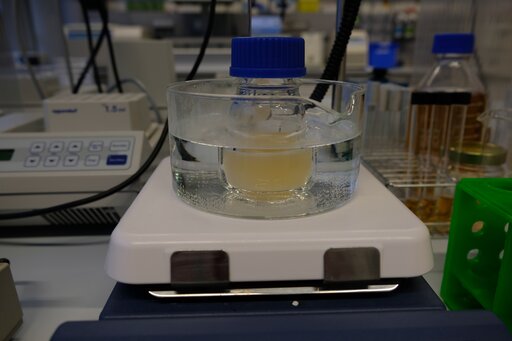
Biofilms are highly relevant as reservoirs for pathogens and antibiotic-resistant bacteria. With our new, scientifically based test method developed from the EU COMBAT project, we are setting standards for hygiene and product safety. We simulate realistic conditions with biofilm samples from drains, e.g., in wet rooms and sinks in hospitals or households, and test disinfectants under practical conditions. At the heart of our innovation is a U-bend model that replicates the complex environment of a drain. This is where biofilms develop as they do in reality – and this is exactly where disinfectants show what they can really do. Through parallel tests with control samples and state-of-the-art analyses (including sequencing on request), we deliver reliable results for your products. On request, the methodology can also be transferred to other water-carrying systems, such as washing machines, air conditioning systems, etc.
Why is this important? Biofilms are stubborn, resistant, and an underestimated risk to hygiene. With our method, we give manufacturers and users the assurance that their products will perform well even under real-world conditions.
In line with our SIMreal approach: progressive, practical, and scientifically tested.
EN 17658 and Beyond: Advanced Virucidal Laundry Testing Under Real Life Conditions
EN 17658 is the established standard for evaluating chemical textile disinfection in the domestic area and remains a key reference for laundry hygiene testing. We offer testing fully compliant with EN 17658, providing reliable, standardized data for regulatory, development, and benchmark purposes.
Building on this solid foundation and based on our peer‑reviewed research Konkol et al. 2024 and Konkol et al. 2025 published in the Journal of Applied Microbiology, we additionally offer an advanced, practice‑simulating test approach that extends EN 17658 to capture the full complexity of real‑world laundering.
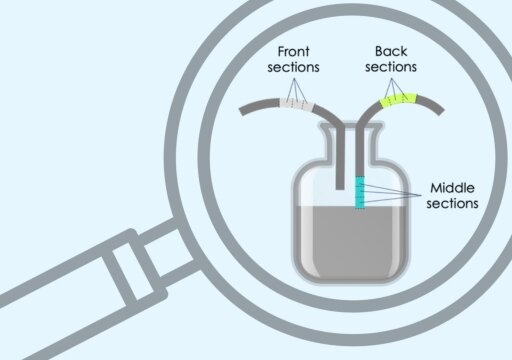
Using a lab‑scale Rotawash washing system, our extended method evaluates the combined effect of chemistry, mechanical action, temperature and time, evaluating the reduction on the textiles, cross‑contamination to sterile textile carriers and the microbial load of the washing liquor—factors that cannot be adequately assessed by classical suspension tests alone.
This enables a realistic assessment of virus removal and inactivation on textiles, as well as virus transfer to other fabrics and the wash liquor, delivering insights that are directly relevant to modern washing practices, including low‑temperature and sustainable laundry concepts.
Whether you require standard‑compliant EN 17658 testing or a deeper, application‑oriented evaluation beyond the standard, we provide scientifically robust, reproducible solutions tailored to your product and development goals.
From compliance to true performance insight—laundry hygiene testing at the next level. If you are interested, please just contact us and we talk.

A New Approach to Evaluate Probiotic Cleaners – Scientifically Sound, Practically Relevant
Probiotic cleaners are increasingly used in domestic and professional hygiene concepts, promising not only effective soil removal but also long-lasting - effects. Established standard test methods were developed for conventional surfactant-based cleaners and often fail to adequately reflect the specific mode of action of microbial-based formulations.
We have developed a novel, adjusted test approach for assessing the cleaning performance of probiotic cleaners under conditions that are close to real-life use. By modifying the established IKW test method for all‑purpose cleaners, we created a setup that allows preconditioning, repeated application, and evaluation of long-term and re‑soiling effects—key aspects for products containing living microorganisms.
The new method enables:
-
Assessment of single-use cleaning as well as pre-treatment scenarios
-
Evaluation of repeated applications and long-term efficacy
-
Direct comparison of probiotic and non-probiotic cleaners, including laboratory-made reference formulations
Using this approach, we can directly compare conventional and probiotic cleaners under identical conditions. This method provides manufacturers, researchers, and formulators with a robust and flexible tool to better understand and substantiate the performance of probiotic cleaning products—and supports the development of innovative hygiene solutions based on sound scientific evidence. If you have any questions, please contact us.
Qualification of dishwashing processes according to IEC 63331
Under the leadership of our laboratory manager (convenor) Dr. Britta Brands, the development of the IEC 63331 standard was successfully completed in the TC 59/SC 59A/WG 3 committee. We are now offering the appropriate services for the qualification of dishwashing processes.
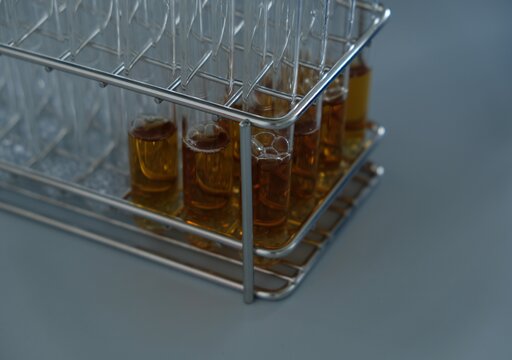
IEC 63331 describes the use of bioindicators with Micrococcus luteus – a BSL-1 organism that is safe and easy to handle. This standard is an important step towards hygienically safe and standard-compliant dishwashers.
Our services at a glance:
-
Test kit for your dishwashers – you carry out the test yourself and evaluate the results independently.
-
Evaluation service – we are happy to analyze the test results for you.
-
Testing in our laboratory – send us your dishwasher and we will carry out the test in-house.
Benefit from our expertise in applied hygiene and ensure hygienically flawless washing results in accordance with current standards.
Do you have any questions, would you like an individual quote, or would you like to learn more about the new standard?
Contact us – we will be happy to advise you!
BB SimReal© method – simulated reality in the laboratory
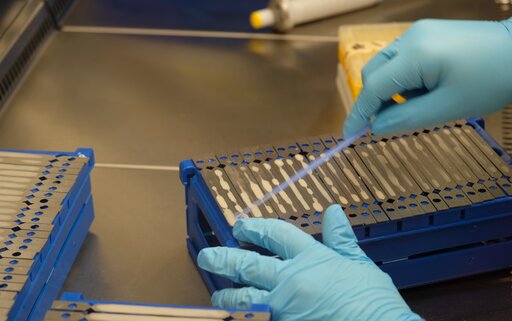
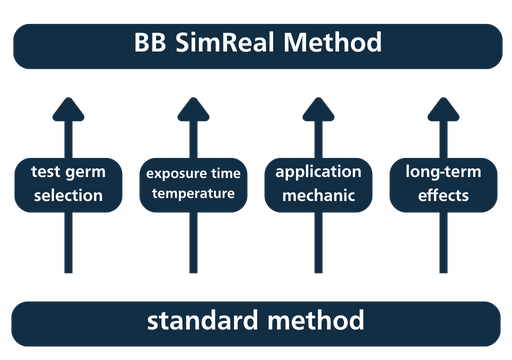
The BB SimReal method uses various standard methods (EN, ISO, DIN, ASTM), but adapts them to the actual conditions in practical application, for example by selecting more relevant test germs, using temperatures or exposure times that are closer to reality, the (additional) application of mechanics or the investigation of possible long-term effects.
In this way, realistic conditions are simulated in the laboratory and thus show the effect of the product under application conditions without losing the informative value of a standard method.
Tests under accredited conditions
Are you interested in standard tests under accredited conditions?
In this case, we can fall back on our strong network, which offers you tests for these methods, among others:
-
Quantitative suspension tests according to DIN EN 1040/DIN EN 1275/DIN EN 1276/DIN EN 1650
-
Testing of disinfection performance on surfaces based on DIN EN 13697
-
Chemo-thermal laundry disinfection according to DIN EN 16616
-
Surface disinfection in the four-field test according to DIN EN 16615
-
Antibacterial activity on surfaces according to ISO 22196